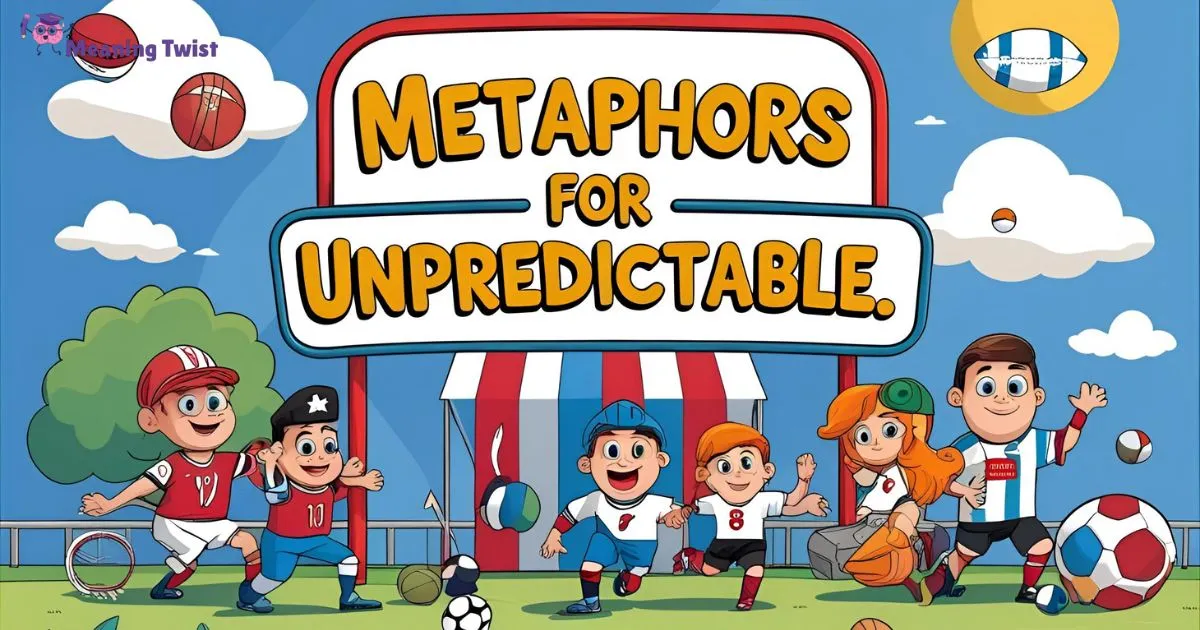
Metaphors for Unpredictable help explain moments and emotions that change suddenly or unexpectedly. A metaphor is a way of describing something by comparing it to something else, using simple words that even Grade 5–6 students can understand. They let us show feelings, moods, or situations in a creative and fun way without saying them directly.
For instance, saying someone’s day is like a “rollercoaster ride” paints a picture of ups and downs and surprises in a clear, relatable way. Using animal metaphors, food comparisons, or lively expressions, you can describe wild emotions, surprising events, or tricky situations with flair.
By learning metaphors for the unpredictable, you’ll gain a playful and expressive tool to communicate sudden changes, exciting twists, or unexpected surprises in your everyday life!
Important Types of metaphors for unpredictable
Best metaphors for unpredictable
Discover the best metaphors for unpredictable moments that capture sudden changes and surprising events with creative expressions. These figurative phrases make it easier to describe wild emotions, unexpected twists, and surprising situations.
- “A rollercoaster ride”
- “Lightning in a bottle”
- “Tornado in a teacup”
- “Box of surprises”
- “Wild card moment”
Funny metaphors for unpredictable
Add humor to your conversations with funny metaphors for unpredictable events or people. These witty comparisons highlight chaos or surprises in a playful, relatable way.
- “Like socks in a dryer”
- “Cat on a hot tin roof”
- “Bouncing popcorn”
- “Monkey on a pogo stick”
- “Hamster on a wheel”
Short metaphors for unpredictable
Use short metaphors for unpredictable to quickly express surprises or sudden changes in daily chats, social media captions, or stories.
- “Sudden storm”
- “Wild spark”
- “Jumping jack”
- “Flying kite”
- “Quick flip”
Metaphors for unpredictable friends
Describe your unpredictable friends with metaphors for unpredictable ones that capture their fun, spontaneous, or surprising personality traits.
- “Firecracker friend”
- “Rolling thunder”
- “Lightning bolt”
- “Popcorn buddy”
- “Tumbling tumbleweed”
Metaphors for unpredictable person
Express the unpredictable nature of a person with creative metaphors that show their surprising actions or moods.
- “Wild card”
- “Chameleon spirit”
- “Stormy cloud”
- “Mercurial mind”
- “Bouncing ball”
Famous metaphors for unpredictable
Learn from the famous metaphors for unpredictable use in literature, movies, and speeches to describe sudden events or unexpected people.
- “Life is a rollercoaster”
- “Man is a river”
- “Chaos in motion”
- “Lightning strikes twice”
- “The winds of change”
Powerful Metaphors for Unpredictable
Compass in Chaos
Meaning:
Describes someone or something that helps find direction in a confusing or unpredictable situation.
When to Use It:
Use it when a friend, teacher, or tool guides you through a tricky or chaotic moment.
In a Sentence:
I acted like a compass in chaos, helping my team figure out the next move.
She was a compass in chaos, guiding us when everything felt messy.
Other Ways to Say:
- Guiding star
- Steady navigator
- Direction finder
Fun Tip or Visual Clue:
Imagine a compass needle spinning wildly but then pointing perfectly north—kids can visualize clarity emerging from confusion.
Roller Coaster Whirl
Meaning:
Describes a situation full of ups and downs, twists, and surprises, just like a roller coaster ride.
When to Use It:
Use it for unexpected events or emotional highs and lows in school, home, or playground moments.
In a Sentence:
I felt like a roller coaster whirl when the surprise game changed all the rules.
He went through a roller coaster whirl, laughing and shouting with each twist.
Other Ways to Say:
- Ups and downs
- Wild ride
- Emotional spin
Fun Tip or Visual Clue:
Picture a roller coaster twisting fast—kids can see how exciting and unpredictable life can feel.
Sudden Storm Surge
Meaning:
Represents a fast, unexpected rush of emotions or events, like a sudden storm hitting without warning.
When to Use It:
Use it when anger, excitement, or surprises appear suddenly, changing the mood quickly.
In a Sentence:
I experienced a sudden storm surge when everyone shouted at the same time.
She felt a sudden storm surge of excitement when she won the race.
Other Ways to Say:
- Sudden rush
- Fast wave
- Quick burst
Fun Tip or Visual Clue:
Imagine dark clouds and wind blowing suddenly—kids can feel the surprise and speed of emotions.
Firework on the Leap
Meaning:
Describes a sudden burst of excitement or energy, like fireworks exploding.
When to Use It:
Use it when someone or something surprises everyone with a lively action or idea.
In a Sentence:
I jumped into the game like a firework on the leap, surprising my friends.
She was a firework on the leap, cheering loudly when the ball scored.
Other Ways to Say:
- Sudden spark
- Explosive move
- Bright burst
Fun Tip or Visual Clue:
Picture a firework shooting into the sky—kids can see energy and excitement bursting out.
Map Torn Apart
Meaning:
Represents a confusing or unpredictable situation where it’s hard to know what to do next.
When to Use It:
Use it when plans fall apart or everything seems mixed up.
In a Sentence:
I felt like a map torn apart when everyone changed their ideas suddenly.
He navigated the game carefully despite the map torn apart scenario.
Other Ways to Say:
- Mixed-up plan
- Chaotic moment
- Confusing path
Fun Tip or Visual Clue:
Imagine a map ripped into pieces—kids can see how tricky it is to find the right path.
Kite in Fury
Meaning:
Describes someone or something moving wildly and unpredictably, like a kite in strong wind.
When to Use It:
Use it when a person or event changes direction suddenly or acts out of control.
In a Sentence:
I ran across the playground like a kite in fury, dodging obstacles everywhere.
She dashed through the room like a kite in fury, full of energy and surprise.
Other Ways to Say:
- Wild movement
- Uncontrolled action
- Flying free
Fun Tip or Visual Clue:
Picture a kite twisting and turning in the wind—kids can see wild and exciting motion.
Cat on Sizzling Roof
Meaning:
Represents someone who is anxious, jumpy, or hard to predict.
When to Use It:
Use it when a person reacts quickly or unpredictably to situations.
In a Sentence:
I felt like a cat on a sizzling roof before my turn in the game.
He jumped around like a cat on a sizzling roof, unsure where to go next.
Other Ways to Say:
- Nervous jumper
- Restless mover
- Quick-reacting person
Fun Tip or Visual Clue:
Imagine a cat hopping carefully on hot tiles—kids can visualize jittery, unpredictable energy.
Volcano on Verge
Meaning:
Describes emotions or events about to explode unexpectedly, like a volcano ready to erupt.
When to Use It:
Use it when someone is about to show strong feelings or an unexpected outburst.
In a Sentence:
I felt like a volcano on the verge waiting to shout in excitement.
She was a volcano on the verge, ready to burst with laughter or frustration.
Other Ways to Say:
- About-to-erupt moment
- Boiling point
- Explosive situation
Fun Tip or Visual Clue:
Picture lava bubbling in a volcano—kids can see energy building up to a sudden burst.
Clock Out of Time
Meaning:
Represents a situation that is confusing, chaotic, or unpredictable, where timing feels off.
When to Use It:
Use it when events don’t happen as expected or schedules get mixed up.
In a Sentence:
I felt like a clock out of time when the game started earlier than planned.
He moved through the class like a clock out of time, unsure of the rhythm.
Other Ways to Say:
- Mixed-up timing
- Off-schedule moment
- Chaotic timing
Fun Tip or Visual Clue:
Imagine a clock with spinning hands—kids can see how confusing time can feel.
Wind Shifts Wildly
Meaning:
Describes a situation or person that changes direction suddenly, like gusts of wind.
When to Use It:
Use it when plans, moods, or events shift unpredictably.
In a Sentence:
I ran across the field as the wind shifted wildly, not knowing where to go.
She reacted quickly like the wind shifts wildly, surprising everyone.
Other Ways to Say:
- Sudden change
- Whirling motion
- Unpredictable twist
Fun Tip or Visual Clue:
Picture leaves flying in gusty wind—kids can imagine sudden, unexpected changes.
Jack Pops Up
Meaning:
Represents someone or something that appears suddenly in an unexpected way, like a jack-in-the-box.
When to Use It:
Use it for surprising actions, sudden arrivals, or unexpected events.
In a Sentence:
I jumped back when a Jack popped up in the game.
He surprised everyone like a Jack pops up, appearing from nowhere.
Other Ways to Say:
- Sudden arrival
- Surprise appearance
- Unexpected jump
Fun Tip or Visual Clue:
Imagine a toy jack springing out of a box—kids can see sudden surprises vividly.
Puzzle Missing Pieces
Meaning:
Describes a situation that feels incomplete, confusing, or unpredictable, like a puzzle missing pieces.
When to Use It:
Use it when information is unclear or events don’t fit together.
In a Sentence:
I felt like a puzzle missing pieces when I didn’t know the next step.
She solved the problem slowly, like a puzzle missing pieces, figuring things out carefully.
Other Ways to Say:
- Confusing situation
- Incomplete plan
- Mixed-up puzzle
Fun Tip or Visual Clue:
Picture a puzzle with gaps—kids can imagine the challenge of figuring things out.
River That Wanders
Meaning:
Represents something moving unpredictably, changing its path like a river.
When to Use It:
Use it for changing moods, unexpected events, or flexible plans.
In a Sentence:
I followed my thoughts like a river that wanders, unsure where they’d go.
She moved through the playground like a river that wanders, exploring different spots.
Other Ways to Say:
- Flowing path
- Meandering course
- Changing direction
Fun Tip or Visual Clue:
Picture a river curving and turning—kids can see natural unpredictability in motion.
Balloon Lost to Breeze
Meaning:
Describes someone or something carried away unpredictably, like a balloon floating off.
When to Use It:
Use it when plans or people move in unexpected directions.
In a Sentence:
I felt like a balloon lost to the breeze when I got separated from my friends.
He drifted around the room like a balloon lost to the breeze, following no fixed path.
Other Ways to Say:
- Floating away
- Drifting unpredictably
- Carried off
Fun Tip or Visual Clue:
Imagine a balloon slipping from your hand—kids can see how things can move without control.
Lightning in a Blink
Meaning:
Represents a fast, sudden, and unpredictable event.
When to Use It:
Use it for quick surprises, flashes of insight, or sudden actions.
In a Sentence:
I solved the puzzle like lightning in a blink, faster than anyone expected.
She dashed across the field like lightning in a blink, surprising everyone.
Other Ways to Say:
- Sudden flash
- Quick surprise
- Instant moment
Fun Tip or Visual Clue:
Picture lightning flashing in the sky—kids can feel speed and suddenness.
Leaf Tornado Ride
Meaning:
Describes chaotic, swirling, and unpredictable motion, like leaves caught in a tornado.
When to Use It:
Use it when things or people move unpredictably, creating chaos or excitement.
In a Sentence:
I spun around like a leaf tornado ride during recess.
She dashed through the leaves like a leaf tornado ride, swirling everywhere.
Other Ways to Say:
- Twisting chaos
- Whirling motion
- Spinning action
Fun Tip or Visual Clue:
Imagine leaves caught in a small tornado—kids can see the spinning, unpredictable movement clearly.
Exercise to Practice Metaphors for Unpredictable
- During the surprise quiz, I felt like a __________, trying to figure out what to do first.
- The day at the amusement park was like a __________, full of ups and downs and unexpected turns.
- When everyone shouted at once, I experienced a __________ of emotions.
- She ran into the playground like a __________, jumping and cheering with excitement.
- Our plan for the class project was like a __________ after the instructions got mixed up.
- The little dog ran around like a __________, darting in all directions.
- I was like a __________, jumping nervously before my turn in the spelling bee.
- He was a __________, ready to erupt with laughter when the joke was told.
- The schedule was confusing, and I felt like __________ trying to keep track of time.
- The group changed their strategy suddenly, like the __________, moving in unpredictable directions.
- During the game, my friend __________, surprising everyone by suddenly joining from behind.
- Solving the riddle was like a __________, missing pieces made it tricky to complete.
- My thoughts wandered around the classroom like a __________, not following any straight path.
- The paper airplane flew away like a __________, carried off by the wind.
Answer Key:
- Compass in Chaos
- Roller Coaster Whirl
- Sudden Storm Surge
- Firework on the Leap
- Map Torn Apart
- Kite in Fury
- Cat on Sizzling Roof
- Volcano on Verge
- Clock Out of Time
- Wind Shifts Wildly
- Jack Pops Up
- Puzzle Missing Pieces
- River That Wanders
- Balloon Lost to Breeze
How to Use Metaphors for Unpredictable in Everyday Conversations
Using Metaphors for Unpredictable in everyday conversations helps you describe sudden changes, surprising events, and unpredictable emotions with creativity and clarity.
By comparing a person, situation, or feeling to a roller coaster, storm, or wandering river, you make your words more expressive, vivid, and relatable.
Whether chatting with friends, explaining school events, or sharing stories at home, these metaphors allow you to communicate tricky feelings in a fun and memorable way, turning ordinary sentences into imaginative, emotionally rich expressions that everyone can understand.
Conclusion
You’re not alone if you’ve ever felt quiet or unsure how to share your thoughts. Everyone experiences it sometimes. Metaphors for quiet give you a creative way to describe these subtle feelings, making tricky emotions easier to express in school, at home, or with friends.
By comparing your silence to a soft breeze or a still lake, you can help others understand your mood without saying it directly. Next time you’re feeling this way, you’ll know exactly what to say!
Keep exploring metaphors and use them confidently to make your words more expressive, relatable, and memorable every day.

Hi, I am Joey, the admin of meaningtwist.com. I simplify deep meanings and twist ordinary words into extraordinary insights to spark your curiosity and clicks!